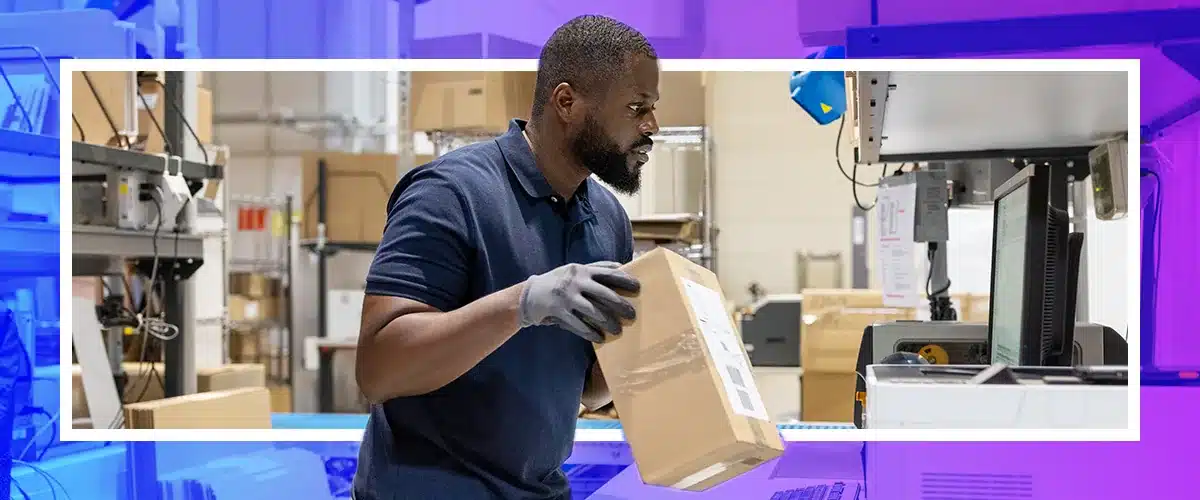

The main difference between batch picking and wave picking is how orders are grouped for fulfillment. Batch picking groups similar items from multiple orders into a single picking trip, while wave picking groups picks according to criteria such as fulfillment schedules, product characteristics, or equipment requirements.
Batch picking vs. wave picking arguments are not new, but the conversation is necessary if you want to optimize order picking and fulfillment within your warehouse. Research shows that the average warehouse worker spends 80% of their shift walking in a warehouse. Most of that walking time goes to finding and picking items to fulfill orders, which is inefficient and contributes to low productivity.
Fortunately, you can resolve these issues by implementing a picking algorithm that reduces walking time and optimizes picking and packing within your warehouse.
Which picking method should you choose? Batch picking and wave picking are both solid choices, but the ideal picking method to implement will depend on your warehouse. In this guide, we’ll discuss both options so you can make the best choice.
Here are the key takeaways from our batch picking vs. wave picking guide:
- Batch picking involves picking the same items for various orders together, while wave picking involves picking items with matching features (such as fulfillment time frame or item size).
- Batch picking is ideal for handling a high volume of orders consisting of small items.
- Wave picking is ideal for coordinating high order volumes based on shared criteria such as fulfillment schedules, product characteristics, or equipment requirements.
- Warehouses can combine batch picking and wave picking algorithms to optimize inventory retrieval.
- Batch picking and wave picking work best with a WMS that optimizes picking with data.
Contents
Batch Picking vs. Wave Picking: Definitions
Batch picking and wave picking are both effective methods for optimizing the pick-and-pack process in warehouses. However, you can’t “pick” between batch picking vs. wave picking if you don’t understand how they work and their benefits. So, we’ve put together a comprehensive explainer of the two warehouse order picking methods.
What Is Batch Picking?
Batch picking is a warehouse picking method that groups items from multiple orders into a single picking trip. Instead of making multiple trips for various items, pickers can combine and pick items in a single picking trip. This warehouse picking method is far more effective than retrieving order items individually, as it reduces the number of trips pickers must make to fulfill orders.
For example, let’s say your warehouse receives Order A for four pens, Order B for three pens and four notepads, and Order C for three notepads. With batch picking, a picker can collect all the pens required to fulfill orders A and B at once. After that, the picker can make another trip to collect all the notepads to complete orders B and C.
Batching orders like this eliminates the need to visit the storage area for pens multiple times to complete different orders. A single trip to complete multiple orders reduces walking time, making pickers more productive and speeding up order fulfillment.
Batch picking is especially useful in warehouses that regularly handle a high volume of orders consisting of small items. It’s also useful if your warehouse typically receives multiple orders with overlapping item requirements (similar items for different orders).
However, this warehouse picking optimization method isn’t ideal for completing orders consisting of large or bulky items. That’s because pickers may not be able to retrieve more than one of these items in a single trip.
What Is Wave Picking?
Wave picking is a warehouse picking method that groups orders or picks into coordinated waves based on shared criteria, such as fulfillment deadlines, product characteristics, or equipment requirements. Like batch picking, it allows multiple orders to be processed together, but uses additional criteria to coordinate when and how items are picked.
With wave picking, pickers collect items with matching features like similar fulfillment time frames or product type/size. Pickers can also group items according to the retrieval equipment needed to get them. For example, is a forklift or cart needed?
Picking order items with the same characteristics prevents multiple trips to the same storage area. Also, following this pattern allows pickers to complete multiple orders simultaneously in a coordinated manner.
For example, if your warehouse receives 100 orders for different items, pickers can form wave picking groups instead of collecting items randomly. One wave group can retrieve all the small-sized items for the 100 orders, while another group collects fragile items, and a third collects large items. Alternatively, one group of pickers can execute waves one at a time.
Consolidating order picking with the wave method eliminates unnecessary travel and increases picking efficiency. It also maximizes labor resources by enhancing coordination and synchronization among pickers.
Benefits of Batch Picking vs. Wave Picking
Both batch picking and wave picking can reduce warehouse travel, improve resource utilization, and increase picking efficiency, but their specific advantages differ based on order profiles and operational requirements.
Batch Picking Benefits
- Prevents accidents: Batch picking eliminates sporadic picks that cause unnecessary foot or vehicle traffic within the warehouse. Fewer pickers moving toward or around aisles of inventory at once reduces the likelihood of accidents. It also prevents bottlenecks, so pickers can get where they need to be faster.
- Maximizes pick volumes: Batch picking requires pickers to retrieve multiple items during each trip to storage areas. Increased pick volumes speed up order retrievals, making batch picking the ideal method for warehouses with lots of SKUs and multi-product orders.
- Optimizes resource use: Batch picking reduces walking time, allowing pickers to work less but be more productive during shifts. Besides optimizing labor, batch picking ensures efficient use of picking equipment. For example, a forklift can retrieve multiple items for different orders in one trip, freeing up the equipment for other users.
- Increases adaptability: Warehouses can easily scale and adapt batch picking to match order volume fluctuations. For instance, your warehouse can assign more batches to pickers during peak periods and fewer batches when things slow down.
- Provides flexibility in workload distribution: Your warehouse can assign batches to pickers based on their expertise or competence. For instance, you can assign batches consisting of fragile items to more experienced pickers. Smaller batches can go to less experienced pickers.
Wave Picking Benefits
- Increases picking efficiency: Grouping orders with similar characteristics into waves allows for the efficient picking of multiple orders at once. Reducing time spent retrieving items leads to faster order fulfillment and happy customers. It also increases worker productivity, contributing to a more profitable warehouse.
- Enhances resource utilization: Warehouses can allocate resources such as picking equipment, personnel, and transportation more effectively, optimizing the usage of available resources.
- Boosts scalability: Like batch picking, warehouses can scale and adapt wave picking to match changing needs. You can adjust the size and composition of waves to match the number of orders. For instance, pickers can move in fewer waves during periods of low order volumes.
- Improves order accuracy: Wave picking helps minimize picking errors by eliminating sporadic picking. Also, since each wave specifies items to collect, pickers can pay closer attention to what they retrieve. Fewer picking errors help improve order accuracy, minimizing order fulfillment errors that lead to costly returns.
- Manages large items: While batch picking works best for retrieving small items, wave picking is suitable for retrieving small and oversized items. It works because you can assign a wave to collect only large or small items. The feature makes wave picking a bit more versatile than batch picking.
Batch Picking vs. Wave Picking: Which Is Best for Your Warehouse?
Neither batch picking nor wave picking is universally better; the right method depends on order profiles, SKU characteristics, warehouse layout, fulfillment schedules, and available labor and equipment.
Warehouses handling large volumes of small, overlapping items may benefit more from batch picking, while operations that need to coordinate picks by deadlines, product characteristics, or resources may benefit more from wave picking.
Alternatively, you can implement wave and batch picking in your warehouse or switch between the two methods as your warehouse needs change. Identify the right picking method for your warehouse by evaluating your warehouse layout, available resources (labor and equipment), and typical order profiles. The insights from your assessment will simplify choosing a suitable picking method.
Regardless of which picking method you choose, a warehouse management system (WMS) can help configure, coordinate, and optimize picking workflows based on your warehouse’s requirements.
How Logiwa IO Supports Warehouse Picking Optimization
All WMS platforms are not created equal. If you want a WMS that leverages data to simplify, optimize, and automate picking and other warehouse processes, choose Logiwa.
Logiwa WMS enables true warehouse picking optimization in several ways. For instance, you can set up a batch picking or wave picking algorithm that fully utilizes your pickers and other resources. Also, Logiwa gives you the power to control various automated picking systems, such as:
- Autonomous mobile robots (AMRs)
- Automated storage and retrieval systems (AS/RS)
- Automated guided vehicles (AGVs)
You can set these systems to operate with your preferred picking method and deliver items to personnel to process for fulfillment.
Another way Logiwa can help with warehouse picking optimization is by improving the picking paths your pickers follow. Improving picker walking paths can shorten the time and distance to reach and retrieve inventory, leading to faster order fulfillment.
Lastly, Logiwa’s analytics feature provides insights into your warehouse processes. With these insights, you can eliminate guesswork and make data-driven decisions to optimize picking and more.
Infinite Picking Algorithm Configurations
Logiwa doesn’t limit you to one picking method. With the WMS, you can implement your preferred picking method and configure it to match your warehouse requirements.
For example, online sellers that manage small items can use Logiwa to configure a batch picking algorithm to manage their peak and slow periods. Are you a third-party logistics company (3PL)? If so, use Logiwa to manage picking small and large items by configuring a picking algorithm that leverages wave and batch picking.

FEFO & FIFO Configurations
FEFO (First Expired, First Out) and FIFO (First In, First Out) are common picking configurations for managing inventory and order fulfillment. FEFO prioritizes picking items with the closest expiration dates and using them to fulfill orders.
For example, if your warehouse stocks perishable goods, you’ll fulfill orders with inventory with the closest expiration date. Doing so prevents losses from inventory expiring before you can sell the products.
On the other hand, FIFO involves picking and fulfilling orders with items that entered your warehouse first (your oldest stock). Like the FEFO system, FIFO prevents losses by sending out older inventory before it loses quality or expires in your warehouse.
With a WMS like Logiwa, you can build picking algorithms around expiration dates, batch numbers, and other critical data from integrated systems.
Automating picking with a FIFO or FEFO configuration will help your warehouse avoid unnecessary inventory and revenue losses. Also, Logiwa WMS allows you to merge multiple picking and inventory management rules such as FEFO, FIFO, and wave picking to optimize your operations.
Optimize Your Warehouse Operations With Logiwa WMS
Whether you choose batch picking or wave picking for your warehouse, optimize your operations with Logiwa WMS. Our industry-leading WMS can help you automate various warehouse processes, including picking and packing. Logiwa WMS can also integrate with the shipping, accounting, ecommerce, and robotics systems you already have. Request a demo today and experience the power of Logiwa.
Optimize multi-warehouse and multi-client operations at both the macro and micro levels
Warehouse Management
Modern digital WMS powers a modern fulfillment experience