
For warehouse managers and third-party logistics teams, inadequate inventory management can spell disaster. Inaccurate counts, stockouts, and back-ordered items all cost businesses time and resources, not to mention damaging the company’s reputation with customers. Fortunately, cloud computing inventory management can help.
Cloud computing inventory management systems replace on-premises servers and static databases with continuously updated platforms, delivering real-time visibility into stock levels across all your warehouses. Distributed teams can access the system from anywhere in the world, updating inventory from the warehouse floor and accessing synced data from a remote office.
This article will explore how cloud automation works and the benefits it provides, like speed, accuracy, and affordability. We’ll also talk about how cloud-based solutions help organizations scale securely.
- The shift from legacy systems to cloud inventory management
- Achieving real-time visibility across multi-location networks
- Core operational benefits for high-volume fulfillment operations
- Comparing technical infrastructure costs and resource allocation
- Selecting the right cloud-based fulfillment management system
- FAQs on cloud computing inventory management
The shift from legacy systems to cloud inventory management
Cloud-based inventory management is a system for tracking, storing, and managing inventory data on remote servers hosted over the internet, instead of on-site servers. Cloud-based tools solve many of the problems raised by the old on-premises inventory systems, which is why many 3PL teams and fulfillment leaders have shifted to new technology.
Legacy inventory systems were built for an older, slower approach to doing business. Inventory data was stored on local servers, which meant updates made at one warehouse weren’t immediately visible to staff at other locations. Decision makers didn’t have instant access to the latest data, which complicated the replenishment and procurement processes. The systems were also expensive, sometimes prohibitively so, and companies relied on in-house IT teams to maintain the servers and databases. This made scaling difficult and required investing in costly infrastructure.
The bottom line is that on-premises systems don’t support the kind of flexible, resilient approach that successful companies need today. Staying competitive in the modern marketplace requires instant access to data, scalable solutions, and ease of use. That’s where cloud inventory management comes in.
Achieving real-time visibility across multi-location networks
Cloud-based inventory platforms allow authorized users to retrieve and update data from any device, anywhere in the world. Warehouse staff can update the system directly from the floor using their mobile devices. Company owners can access the latest data remotely for forecasting and predictions about market demand. Customer service representatives can check inventory levels and answer customers’ questions about availability.
The cloud-based platform serves as a single source of truth, a central repository for inventory information across all of a company’s warehouses and retail channels.
A 3PL managing fulfillment for ten different retail clients can give each client a live portal view into their own inventory. A nationwide distribution network can decide how best to locate its stock based on real-time demand and availability, instead of stale data. The list goes on.
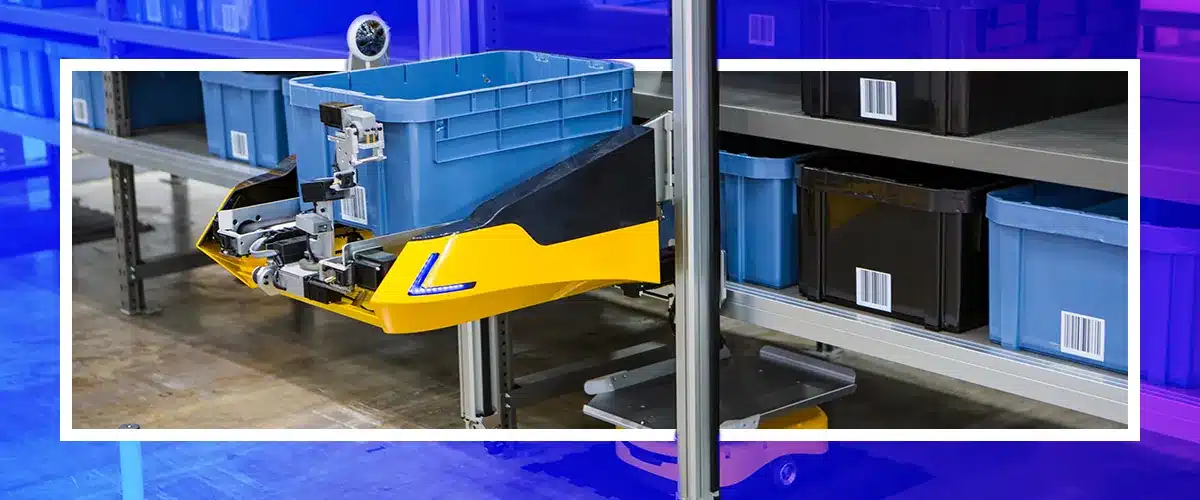
Because they offer real-time visibility, cloud inventory systems also support the ongoing boom in automation across warehouses and fulfillment centers. Autonomous mobile robots (AMRs) and AI-powered robots, for example, function best when they have access to high-quality inventory data. Storing that data on the cloud makes it easier to organize, store, and share it at scale.
Core operational benefits for high-volume fulfillment operations
Cloud platforms deliver high-quality, actionable data in real-time, supporting better decision-making and customer service. This translates to greater operational efficiency and a solid reputation in the marketplace.
These benefits are all supported by microservice architecture, which is a design approach where the platform is built as a collection of independently functioning modules rather than a single monolithic system. In practical terms, this means the inventory management platform connects to external marketplaces, carrier systems, and enterprise resource planning (ERP) platforms through standardized application programming interfaces (APIs), without requiring custom-built integrations for every new connection.
For high-volume operations, that speed and flexibility make a huge difference. Microservice architecture enables seamless integrations with technologies reshaping inventory management, like AI-driven orchestration platforms and robotics. Those integrations lead to faster order processing, quicker and more reliable fulfillment, and fewer oversells.
Discover Network-wide Real-time Visibility
Comparing technical infrastructure costs and resource allocation
Cloud-based inventory management operates on a fundamentally different model from on-premises inventory solutions.
On-premises systems require a large upfront capital expenditure. The organization must buy, install, and maintain dedicated servers to house inventory databases. That means allocating physical space for the servers and hiring an in-house IT team to manage the system. If the business grows or expands to a new facility, the company needs to invest in more infrastructure, not to mention licensing the on-premises software.
Cloud platforms, in contrast, work on a subscription basis. Infrastructure costs are distributed across all the vendor’s customers, giving subscribers access to top-of-the-line software at a relatively low cost. Users don’t need to buy and maintain dedicated servers. Likewise, when organizations scale, there’s no major investment required to expand to a new location, because there’s no new hardware to purchase.
Cloud subscribers don’t need to hire IT professionals to maintain their hardware. For teams that already have a strong IT team, there’s a further benefit: those computing experts can focus on high-level strategic work that adds value to the organization. There will always be exceptions, but in most cases, cloud solutions are more affordable and better-suited to organizations in the growth stage.
Selecting the right cloud-based fulfillment management system
There’s a lot of variation among cloud-based inventory platforms, and it’s important to choose the one that’s right for your business. Looking ahead, it’s especially important to choose a system that integrates cleanly with other state-of-the-art fulfillment technologies, like AI-powered robotics, autonomous mobile robots, and collaborative robots.
It’s a good idea to look for cloud-based systems that offer:
- Microservice architecture for seamless integration with retail channels, carriers, ERPs, and robotics
- Real-time inventory sync so that stock levels update instantly across locations and channels, not on a batch basis
- Multi-client and multi-location support that can segregate data and client-specific workflows
- UI/UX and ease of configuration so that you can customize to your heart’s delight
- Intuitive permissioning features so that administrators can control configuration changes
- AI-readiness so that, as AI penetration deepens, your platform is ready to integrate with new data sources and connect with AI-driven orchestration platforms
- Scalability, with pricing that makes it easy to expand your inventory management solution to match your growth
Many of these features are forward-looking because the right platform is foundational for every automation investment that follows. It’s a good idea to look for a platform like Logiwa IO, with its strong automation and AI tools, that make it easy to run a digital warehouse. Our cloud solutions drive improvement in every facet of business, from warehouse space optimization to vendor management.
When you’re ready to see what a modern cloud fulfillment platform can do for your business, schedule your free demo with Logiwa.
FAQs on cloud computing inventory management
How does cloud computing shift inventory management from “reactive” to “predictive”?
While traditional systems tell you what you had, 2026 cloud-native platforms use Machine Learning (ML) to forecast what you’ll need. By analyzing real-time data and historical sales, these systems trigger automated replenishment before a stockout even occurs, effectively moving 3PLs from a defensive posture to a proactive strategy.
Why is microservice architecture considered “future-proof” for 3PLs?
Unlike monolithic legacy systems, microservice architecture breaks the platform into independent modules (e.g., one for shipping, one for returns). This allows 3PLs to integrate new tech—like AI-driven orchestration or humanoid robotics—without a total system overhaul. If one service fails or needs an update, the rest of the warehouse stays online, ensuring zero-disruption operations.
Can cloud-based inventory systems help 3PLs retain high-value retail clients?
Yes. Recent 2026 industry data shows that 74% of shippers would switch 3PL providers based specifically on their AI and real-time visibility capabilities. Providing clients with a live portal view of their stock levels and predictive insights isn’t just a “nice-to-have” anymore; it’s a critical retention tool in a market where transparency builds the most trust.
How do IoT and RFID technology enhance real-time stock tracking?
Cloud systems act as the “brain” for IoT sensors and RFID tags. Instead of manual cycle counts, these devices provide continuous, hands-free updates on item locations and conditions (like temperature or tilt). This data is synced instantly to the cloud, giving warehouse managers a digital twin of their physical inventory that is accurate to the second.
Is a hybrid cloud model better for warehouses with poor connectivity?
For facilities in remote areas or those with strict data residency requirements, a hybrid model is often the “practical default”. It keeps critical, low-latency tasks (like real-time robotics control) on local servers while using the public cloud for heavy-duty data analytics, global visibility, and multi-location syncing.
What are the primary security benefits of cloud inventory management in 2026?
Modern cloud providers offer “layered security” that most in-house IT teams can’t match, including AI-driven threat detection and automated patching. Because responsibility is shared, the provider secures the physical infrastructure while the user controls granular permissions, significantly reducing the risk of data breaches caused by neglected on-premises server maintenance.