
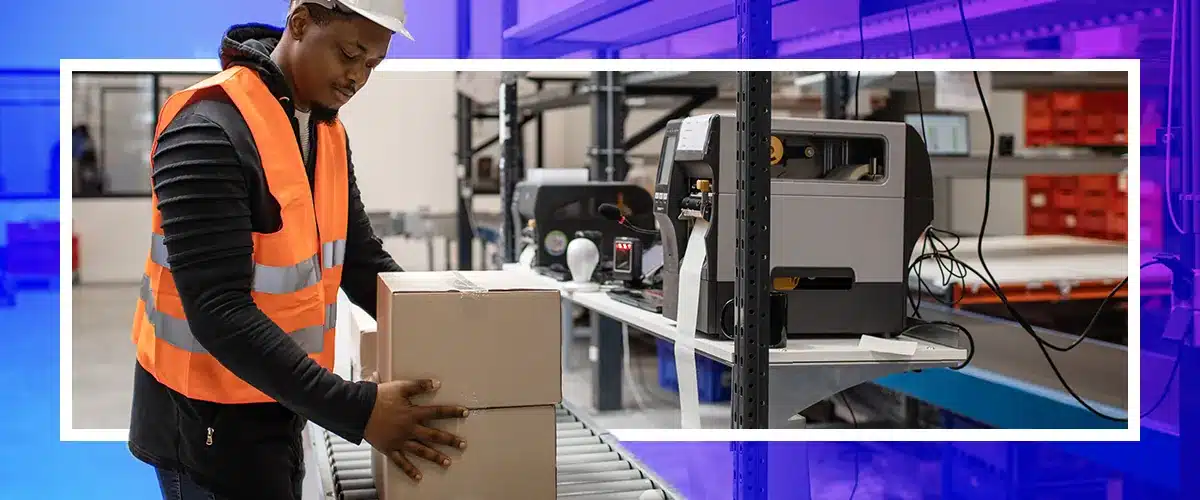
Warehouse owners and 3PL providers are under constant pressure to deliver orders quickly, reliably, and in perfect condition. Automated conveyor and sortation systems make that much easier.
Automated conveyor and sortation systems use a system of belts, rollers, and chains to direct goods fulfillment facilities. Software integrations and smart tools increase throughput and reduce manual labor. The result is a continuous, intelligent product flow, from the receiving docks to the outbound shipping lanes, that ensures faster and more accurate deliveries.
This guide walks through how automated conveyor and sortation systems work, touching on the concrete benefits of different systems and the additional benefits of deploying them with software solutions.
- How automated conveyor and sortation systems function together
- Common types of sortation technology for high-volume fulfillment
- Core benefits of implementing automated material handling systems
- Strategic considerations for scaling warehouse automation networks
- FAQs on automated conveyor and sortation systems
How automated conveyor and sortation systems function together
Conveyor networks and sortation systems are distinct technologies, but they’re designed to work as one. Conveyors are a core element in a warehouse’s physical infrastructure. They’re essentially like roads, moving horizontally, vertically, and across zones in the storage facility.
Sortation systems identify items, using barcodes or RFID tags, while they’re moving down the conveyor belt. The sortation systems then divert each item onto the right conveyor pathway so that they reach their correct destination, whether that’s a packing station, shipping lane, or returns processing area.
The sortation and conveyor systems form a closed loop. Conveyors keep all the products moving without the need for constant manual lifting. Sortation systems ensure every item reaches exactly the right place without frequent manual interventions. Together, the two systems significantly increase the pace of picking, packing, and staging orders.
Common types of sortation technology for high-volume fulfillment
Sortation technology spans a wide range of tools, each suited to a different environment:
- Pop-up wheel and roller sorters use rotating wheels that rise, or “pop up,” from beneath the conveyor belt and turn at an angle, directing certain items onto a secondary path. They’re a good choice for facilities with limited space, and they’re especially effective for handling small to medium-sized items in standardized shapes.
- Sliding shoe sorters use small plastic or rubber blocks, called “shoes,” to push items off the main conveyor belt onto the appropriate secondary path. Shoe sorters are fast and highly accurate, making them a good choice for high-speed, mixed-SKU environments. However, they involve a large upfront cost and regular maintenance.
- Cross-belt sorters use a series of small belts mounted on a carrier, which is mounted atop the main conveyor system. As the items move down the conveyor and reach their destinations, the belt on the carrier moves to drive the item into the appropriate chute or pathway. Cross-belt sorters excel at handling small or irregularly shaped items.
- Tilt-tray sorters are similar to cross-belt sorters, except that instead of small belts, they use tilting trays to drop items into chutes. They’re fast and gentle, making them a good choice for fragile, delicate items.
For warehouses that also use automated storage and retrieval systems to manage inventory, sortation technology integrates directly with those systems.
See how Logiwa IO optimizes automation
Core benefits of implementing automated material handling systems
Transitioning from manual sorting to automation speeds up workflows, but it also delivers other important benefits.
Increasing labor efficiency
The old-fashioned, manual sorting strategies require pickers, scanners, and sorters to be stationed at key points along the conveyor belt. Automated sortation systems for 3PLs and large-scale fulfillment centers eliminate most of those touchpoints so that the same crew can manage a much higher order volume.
Reducing error
Manual sorting is often full of errors. Workers can easily get bored, tired, or distracted when they perform repetitive tasks like parcel sorting for long periods of time. That can lead to items getting miscategorized or even damaged. Automated tools virtually eliminate the risk of human error, and they also free up employees to focus on more complex, interesting tasks.
Enabling scaling
A well-designed conveyor and sortation network allows 3PL providers or warehouse managers to manage more order volume with ease. Instead of hiring and training extra staff during busy seasons, managers can use the automated system to extend the capacity of the existing team.
Integrating warehouse software with conveyor and sortation hardware
Without the right directions, even the most sophisticated conveyor network won’t increase efficiency or speed up fulfillment workflows. That’s where warehouse logistics automation software tools like warehouse execution systems (WES) and warehouse management systems (WMS) come in.
WES and WMS collect and analyze warehouse data and then communicate with all the conveyors and sorters in the facility to route items based on live order routing data.
As soon as your team scans the barcode on an incoming item, the software already knows the item’s destination, down to the shipping lane, carrier, and time window. Based on that data, the system plans an ideal route through the warehouse and signals the conveyor and sortation hardware.
The best software includes real-time data sync. Data lags can easily create misroutes, where items end up in the wrong lane or orders are split incorrectly. Data sync enables last-minute rerouting as necessary, avoiding bottlenecks and ensuring items reach their destination in time.
Kardex’s material handling resource offers a deep dive into the latest technology involved in moving, storing, and managing materials in the warehouse. Logiwa’s fulfillment management platform operates in direct partnership with Kardex, enabling seamless software-hardware coordination for high-volume 3PL providers and warehouse managers.
Strategic considerations for scaling warehouse automation networks
Managing a high-volume fulfillment flow is a complex process. Choosing the right conveyor and sorting system is the first step. The second, equally important step is selecting the software to manage your physical infrastructure.
The right combination of hardware and software helps teams manage peak season busy periods and scale at a low cost. The right software is critical for managing busy multi-site operations. For smaller organizations, too, the right software can improve hardware automation ROI by extending the reach of a lean crew and optimizing a limited space.
Logiwa’s platform goes beyond traditional WMS capabilities, integrating warehouse management with real-time inventory control and AI-powered picking and packing automation. The platform gives managers access to all the data and automated tools they need in one, central location.
If you’re evaluating how automated conveyor and sortation systems fit into your fulfillment strategy, request a demo with Logiwa to see how integrated warehouse software supports high-volume automation at scale.
FAQs on automated conveyor and sortation systems
How is Artificial Intelligence (AI) transforming automated parcel sorting?
AI-driven computer vision and machine learning models are transitioning parcel sorting from rigid, barcode-dependent systems into adaptive, highly autonomous environments capable of handling unstructured workflows.
- Advanced Computer Vision: Modern sorting systems integrate Red-Green-Blue-Depth (RGB-D) sensors and advanced convolutional neural network architectures to identify, localize, and predict 3D spatial poses for items in cluttered or severely occluded environments.
- Real-Time Predictive Manipulation: Instead of relying solely on fixed scanning fixtures, AI enables robotic sorters to execute adaptive “push-and-grasp” strategies, actively sorting through disordered piles to isolate irregular items.
- Dynamic Flow Control: Embedded microcontrollers utilize neural networks to analyze conveyor speeds and feed rates dynamically, improving overall throughput while minimizing operational energy consumption.
What are reinforcement learning-driven modular conveyor systems, and what are their benefits?
Next-generation modular systems utilize Deep Reinforcement Learning (DRL) to manage high-density package transportation within tight physical footprints.
- Grid-Based Scalability: Unlike traditional conveyor tracks that form fixed networks, these systems are built from repetitive, independent square conveyor modules that allow rapid physical reconfiguration.
- Module-Centric Scheduling: Traditional software tracks individual package routes; however, reinforcement learning models assign actions directly to individual conveyor modules rather than the packages themselves. This decentralized shift dramatically reduces scheduling overhead in high-throughput pipelines.
- Cost Effectiveness: Assembling pipelines from standardized, repetitive modules achieves high-density sorting within compact footprints while driving down maintenance costs.
How does warehouse layout optimization impact the efficiency of high-volume sorting centers?
Maximizing the ROI of automated sorting hardware relies heavily on mathematical layout planning to eliminate processing bottlenecks and maximize volumetric facility utilization.
- Systematic Layout Planning (SLP): Modern hub-level distribution facilities leverage SLP frameworks to map out optimal routing from inbound receiving docks directly to outbound shipping lanes.
- Genetic Algorithm (GA) Optimization: Logistics networks deploy multi-objective genetic algorithms to automatically design express processing layouts, simulating thousands of routing configurations to find the absolute shortest internal travel distance.
- Quantifiable Space Maximization: Integrating these intelligent algorithms into layout design has been proven to increase facility space utilization by 15% to 28% compared to legacy manual mapping methods.
How do modern automated sorting lines utilize neural networks to prevent parcel damage?
Automated sorting lines are increasingly utilizing Feed-Forward Neural Networks (FFNNs) to make smart, real-time downstream routing decisions based on physical parcel dimensions and weight rather than just barcode data.
- Volumetric Classification: Advanced artificial neural networks analyze conveyor flows to automatically categorize parcel mixtures into distinct weight and dimensional ranges.
- Smart Truck Staging: This physical classification data is communicated in real time to outbound chutes, enabling smart staging where heavier items are loaded first to create stable cargo structures.
- Damage Mitigation: Pre-sorting parcels by their physical dimensions prevents heavy items from crushing fragile goods, working in tandem with delicate hardware like tilt-tray sorters.