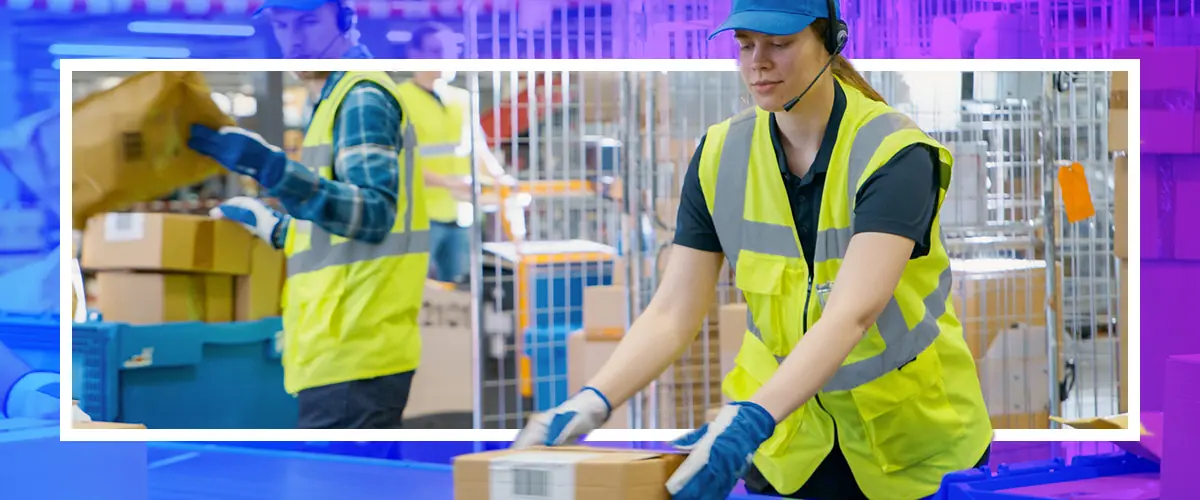
Logistics workers are often stretched thin, especially during peak seasons, when they must walk long distances to pick and pack items quickly. Over time, this physical strain leads to fatigue and picking errors, which can harm brand reputation and fuel disengagement and turnover.
To address these challenges, an increasing number of third-party logistics (3PL) companies are adopting Autonomous Mobile Robots to help human workers with repetitive, labor-intensive tasks. This article explains the meaning of AMR robots and why they’ve become a practical, scalable solution for 3PLs and high-volume fulfillment environments.
Contents
- What AMR robots are and how they support modern warehouse operations
- How AMRs fit into a broader warehouse automation strategy
- When AMRs make the most sense for 3PLs and high-volume fulfillment operations
- Why hardware alone cannot deliver full automation ROI
- The role of an AI-driven WMS in coordinating AMRs and other automation systems
- FAQs on deploying AMR in 3PL environments
What AMR robots are and how they support modern warehouse operations
AMR robotics can navigate warehouses and perform tasks without human intervention. They do this through mapping, localization, and dynamic decision-making.
First, AMRs use simultaneous localization and mapping (SLAM) algorithms to build and continuously update a real-time map of the warehouse. This enables them to understand their surroundings and navigate safely around shelving, walls, partitions, and other structures.
Once it has a map of its surroundings, an AMR calculates the best route on the go. If it encounters obstacles, such as a stray box or human workers, it can reroute or stop automatically. This adaptability makes AMRs particularly effective in busy warehouses where layouts and conditions change frequently throughout the day.
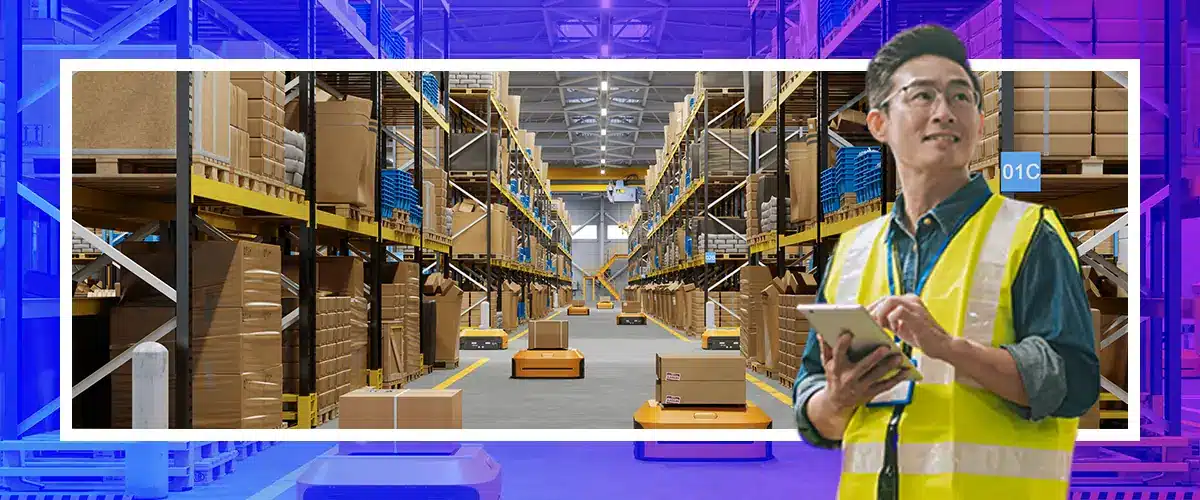
In 3PL environments, teams often use autonomous mobile robotics for repetitive, high-strain tasks such as order-picking assistance, tote or cart transport, replenishment moves, and putaway operations. By taking over internal transport tasks, AMRs reduce walking distance and physical fatigue for warehouse staff, giving them more time to focus on higher-level activities. The result? Improved throughput, fewer errors, and higher productivity, all without increasing headcount, especially when teams follow automated warehouse robot guide best practices.
How AMRs fit into a broader warehouse automation strategy
While AMRs can deliver immediate efficiency gains on their own, they are most effective when teams deploy them as part of a broader warehouse automation strategy. For 3PLs, this usually includes integrating AMR robots with other high-impact technologies.
- Automated storage and retrieval systems (ASRS) use computer-controlled shuttles or robotic mechanisms to store and fetch inventory within dense, vertical storage environments. While these systems excel at high-speed retrieval, they need complementary technologies to move inventory horizontally across the warehouse. AMRs fill this role by moving totes and cartons between zones, minimizing the need for manual labor and easing physical strain on workers.
- Conveyors remain essential for predictable, high-throughput transport along predefined paths, but are less effective in environments where demand patterns or layouts change frequently. AMR robots can help conveyors adapt to these environments by dynamically rerouting around obstacles or congestion as conditions evolve. This allows warehouses to maintain speed without sacrificing flexibility.
- Robotic picking systems use AI-powered robotic arms, vision technology, and sensors to identify, grasp, and place items, significantly boosting efficiency and accuracy. AMRs support these systems by delivering inventory to pick stations and transporting completed orders to downstream processes such as packing or sortation.
Sortation systems are typically located near outbound stations. They identify, classify, and route products to the correct dock, shipping lane, or carrier at high speed. AMRs can help maintain consistent input into these systems by moving orders from packing or consolidation areas and reducing manual handling errors and delays.
When AMRs make the most sense for 3PLs and high-volume fulfillment operations
AMRs deliver the most value when operational demands start outpacing what manual workflows can reasonably support. For 3PLs and high-volume fulfillment operations, readiness usually shows up in several ways:
- Rising order volumes: As throughput increases, manually moving inventory between storage, picking, and outbound areas becomes harder to scale without hiring new people or overworking staff.
- High picker travel time: In large facilities, workers may spend a disproportionate amount of each shift walking rather than picking. AMRs reduce non-value-added travel by handling internal transport, freeing workers to focus on packing and exception management.
- Labor constraints: High turnover in the logistics industry and the physical demands of warehouse work make scaling through hiring alone increasingly unreliable, especially during peak seasons.
- Facility layout readiness: Facilities with adequately wide aisles, manageable congestion zones, and clear separation between pedestrian and robot traffic make it easier for AMRs to work safely and efficiently.
- SKU and order profile stability: AMRs perform best in warehouses with relatively consistent item sizes, predictable order frequencies, and structured pick paths.
Operational maturity: Before deploying automation, warehouses should have standardized processes, accurate inventory data, and a reliable warehouse management system (WMS) in place to orchestrate robotic tasks and prevent new bottlenecks.
Why hardware alone cannot deliver full automation ROI
While AMRs are powerful, they don’t immediately deliver a clear return on investment on their own. Without the right software backbone, you may bump into many limitations, including robots sitting idle while waiting for instructions, congested aisles caused by uncoordinated movement, and low overall utilization of costly robotic assets.
These issues arise because AMRs require continuous, real-time orchestration. A high-performance, cloud-native, AI-driven WMS software is essential for coordinating task allocation, routing decisions, and exception handling across human and automated workflows. By centralizing operational data in a single hub and analyzing it in real time, the right WMS can record and automate data-driven decisions that keep robots moving and automation investments performing at scale.
The role of an AI-driven WMS in coordinating AMRs and other automation systems
To make the most out of AMRs, teams must combine warehouse robotics and WMS software. Besides managing AMR tasks, WMS enables teams to coordinate ASRS, conveyors, and manual labor. They’ll also get access to real-time data flow for optimized routing, prioritization, and load balancing, resulting in a clear relationship between robotics and efficiency.
If you’re looking for a reliable AI-driven WMS for coordinating AMRs and other automation systems, consider Logiwa WMS. Our cloud-based WMS provides a wide range of features at your fingertips, including mobile apps, automation rules, online reports, and real-time exception handling. Request a demo today to see how it can fit into your workflow.
FAQs on deploying AMR in 3PL environments
What is the difference between an AMR and an AGV?
While both move inventory, the key difference is navigation. Automated Guided Vehicles (AGVs) follow fixed paths (like magnetic tape or wires) and stop if an obstacle blocks them. In contrast, Autonomous Mobile Robots (AMRs) use advanced mapping (SLAM) and sensors to understand their environment. If an AMR encounters an obstacle—like a box or a person—it can dynamically recalculate its route and navigate around it, making it far more flexible for busy 3PL warehouses.
Will implementing AMRs replace my warehouse workforce?
No, AMRs are designed to assist workers, not replace them. In 3PL environments, AMRs take over repetitive, low-value tasks like internal transport and long-distance walking. This reduces physical fatigue and allows human workers to focus on high-value activities like complex packing and exception management. The goal is to improve throughput and productivity without needing to increase headcount during peak seasons.
How do AMRs integrate with existing warehouse systems?
Hardware alone cannot deliver full ROI; AMRs must be orchestrated by software. A modern, AI-driven Warehouse Management System (WMS) acts as a central hub, coordinating tasks between AMRs, conveyors, and manual workflows. The WMS analyzes real-time data to optimize routing and task allocation, ensuring robots don’t sit idle and that inventory moves efficiently between zones.
Are AMR robots safe to operate alongside human workers?
Yes. AMRs are specifically designed for collaborative environments. They utilize real-time mapping and “simultaneous localization” to detect shelving, walls, and people. If a worker crosses an AMR’s path, the robot’s dynamic decision-making capabilities allow it to stop or reroute automatically to prevent collisions. This makes them safe for facilities with mixed traffic where pedestrians and robots share the same aisles.
When is the right time for a 3PL to invest in AMRs?
A 3PL is ready for automation when manual workflows can no longer scale with demand. Key indicators include rising order volumes that strain current staff, excessive travel time for pickers, and difficulty hiring enough labor during peaks. Additionally, having a facility with adequate aisle widths and a reliable WMS in place are critical prerequisites for a successful deployment.