Warehouse and fulfillment technology has reached a new level, and leaders in the field are already reaping the benefits. Today, state-of-the-art tools like artificial intelligence (AI) and autonomous mobile robots are speeding up every stage of the fulfillment process, from inbound receiving to last-mile dispatch.
In this article, we’ll explore this year’s most promising trends, like AI-powered robotics, automated storage and retrieval systems, and Robots-as-a-Service. We’ll also explain the benefits of key warehouse automation technologies so you can decide what’s right for you.
- Essential warehouse automation trends for quick implementation
- The evolution of mobile robotics and autonomous navigation
- AI-driven fulfillment management and software-defined warehouse systems
- Improving order accuracy with intelligent picking and IoT sensors
- Sustainability and automated packaging solutions in modern warehouses
- FAQs on warehouse automation trends
Essential warehouse automation trends for quick implementation
In a year that’s been full of innovation, three smart warehousing technology trends stand out.
AI-powered robotics
AI capabilities such as computer vision and path-planning algorithms enable warehouse robots to “see” their environment and plan efficient paths through a crowded warehouse. Machine learning (ML) technology allows robots to learn from their environment and, over time, improve their performance. Solid state drive (SSD) enables long-term memory and rapid response to change. The robots are also equipped with robotic arms or gripping tools so they can grasp items.
AI-powered robots have been widely adopted by leaders in global fulfillment. They typically operate in warehouses, picking items, packing shipments, and updating inventory. The robots effectively reduce manual labor on the most physically demanding tasks, while speeding up processes. Robot-as-a-Service (RaaS) offers flexible subscription-based or pay-per-use access to robots, making them a good choice for teams without the budget for major investment in new assets.
Autonomous mobile robots
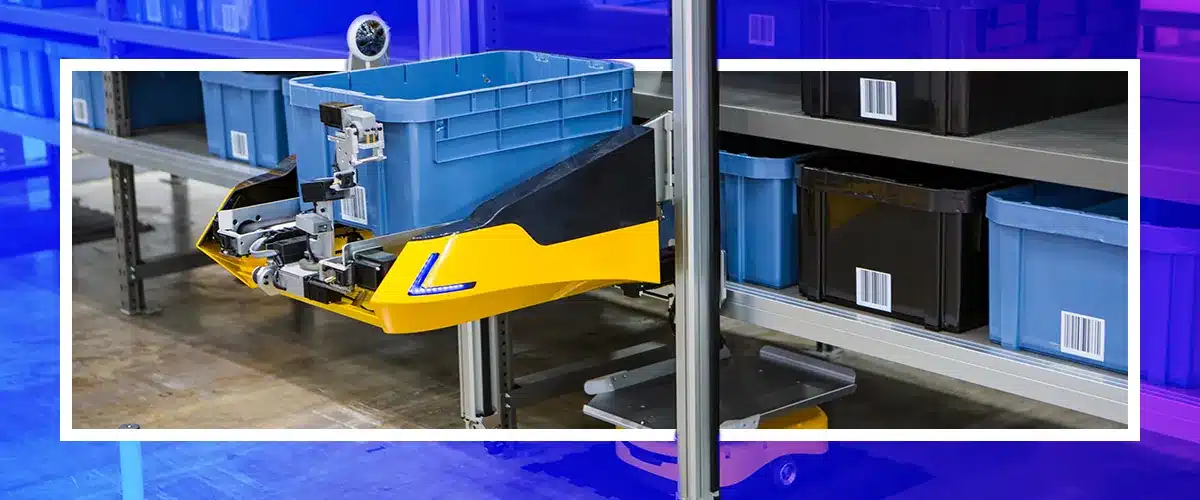
Autonomous mobile robots (AMRs) are designed to transport goods, shelves, pallets, and other items from one location to another within the warehouse. Built-in sensors allow AMRs to adapt to floor changes in real time; unlike earlier technology, the new generation of robots doesn’t depend on magnetic tape or reflective strips to navigate the warehouse. The technology is inherently modular and can be easily scaled up or down, without changing the warehouse infrastructure.
Advanced Fulfillment Management Systems (FMS)
A fulfillment management system like Logiwa IO operates as a central management tool that ties together robotics, conveyors, sorters, and human workflows. The platform integrates with order management systems and then, using AI, plans warehouse operations based on incoming orders, assigning tasks and automatically adjusting plans when there’s a mechanical failure or a logistical change.
The evolution of mobile robotics and autonomous navigation
Two new technologies are making it easier for warehouse managers to scale operations: autonomous navigation and cobotics.
Autonomous navigation
Many fulfillment leaders have transitioned from using automated guided vehicles (AGVs) to autonomous mobile robots. AGVs, while reliable, depend on tools like magnetic tape, reflective markers, or embedded wires for navigation, which restricts floor layouts and makes it difficult to reconfigure the warehouse to fluctuating stock levels.
AMRs, on the other hand, use autonomous navigation tools like onboard lidar, cameras, and AI mapping technology to move through the warehouse. They can also automatically reroute to avoid hitting obstacles. Because they are so flexible, AMR fleets are easy to scale. The result is an operation that can grow with demand and scale back as necessary.
Cobotics
Cobotics, or collaborative robots that work alongside human warehouse teams, deliver automated technology without requiring extensive infrastructure changes. They help workers with tasks like heavy lifting, label application, and cart replenishment. Used correctly, cobots take over the most tiring, repetitive manual tasks and free up workers to focus on quality control or complex fulfillment tasks.
By taking over these labor-intensive jobs, cobots allow warehouse teams to get more done with limited resources. They don’t take over human jobs; instead, they extend the capacity of human teams. This makes it much easier for warehouses to scale up their productivity during busy seasons without investing in hiring and training a large labor force.
AI-driven fulfillment management and software-defined warehouse systems
AI-native fulfillment management systems coordinate conveyor systems, robots, and pick-and-pack arms, resolving common 3PL warehouse automation challenges.
AI excels at pattern identification and predictive analytics. For warehouse orchestration tools, that means using predictive modeling to anticipate workloads and create schedules. It also means predicting and correcting for bottlenecks.
Advanced fulfillment management systems stream data from across the warehouse operation, including dock sensors, robot telemetry, and order management software. The platforms use that data to make predictions, create plans, and reroute tasks in real time when there’s a logistical or mechanical issue.
The best AI-driven platforms, like Logiwa IO, deliver optimized warehouse and fulfillment management, integrating seamlessly with automated and AI tools.
AI orchestration in micro-fulfillment centers
Micro-fulfillment centers (MFCs) combine high-density automated storage and retrieval systems (AS/RS) with AI orchestration to deliver goods to customers at high speed.
MFCs are typically located in or near cities. They’re much smaller than traditional warehouses, and they make extensive use of automation and robotics. When an order comes in, the orchestration platform coordinates robots on the warehouse floor, creating efficient picking and packing plans. The orchestration layer is crucial for preventing bottlenecks and collisions, and for ensuring that orders go out quickly and accurately.
Move your fulfillment ahead with Logiwa IO
Improving order accuracy with intelligent picking and IoT sensors
Today’s customers expect fast, reliable, and accurate deliveries every time. Computer vision and Internet of Things (IoT) tools can help.
Vision-enabled picking robots use built-in cameras and computer vision algorithms to “see” the items they’re picking, so they can tell when a wrong item is on the shelf or when there’s a problem with the item’s quality. Vision-enabled robots can also identify and grasp items that are jumbled in a bin or vary in shape and size across SKUs. This helps the robot to pick the right item, even when it’s stored in the wrong place or does not come in a standard form.
IoT sensors and autonomous inventory drones help improve inventory accuracy. Drones scan barcodes and RFID tags across racks at high speed, delivering fast, accurate data so items are easy to locate when needed.
Other IoT tools like “smart” shelves can issue alerts when stock gets low, so that key items are always reordered on time. The result is a warehouse that runs smoothly, with minimal time wasted searching for items or picking incorrect items.
Sustainability and automated packaging solutions in modern warehouses
Warehouse automation technology isn’t just about increasing efficiency — it’s also key to improving sustainability. Amid increased regulatory pressure, consumer expectations, and corporate ESG commitments, automated systems are an important means of reducing waste in the fulfillment sector.
Automated right-sizing systems reduce excess corrugated packaging. Automated pallet optimization software organizes shipments to maximize container space and minimize the number of shipments required, reducing fuel consumption. The result is lower costs as well as lower emission rates.
The right warehouse management and fulfillment service can help your organization make the best possible use of new technology. From choosing the right tools to planning and deploying AI devices, Logiwa can help.
Logiwa is a leader in the warehouse management and fulfillment space. Our intuitive tools make it easy to run a digital warehouse and scale to your heart’s content. Contact the Logiwa team today to learn how our fulfillment platform can help you scale smarter.
FAQs on warehouse automation trends
Beyond standard Autonomous Mobile Robots (AMRs), what are autonomous forklifts and how do they impact warehouse layouts?
Autonomous forklifts represent a specialized segment of physical automation designed to integrate into existing warehouse infrastructures without requiring a complete, costly facility redesign. While general AMRs transport lighter goods, shelves, or pallets across open floors, autonomous forklifts handle heavy-duty material movement within traditional racking setups.
They differ fundamentally from standard AMRs due to unique engineering demands:
- Complex Steering Dynamics: They utilize specialized rear-wheel steering configurations (such as bicycle or offset tricycle models) that require distinct kinematic mapping for tight warehouse aisles.
- Payload Stability: They rely on real-time adaptive control systems to account for fluctuating weight distributions during high-elevation pallet manipulation.
- High-Precision Placement: Modern units leverage advanced Simultaneous Localization and Mapping (SLAM) systems alongside Time-of-Flight (ToF) cameras to achieve millimeter-level placement accuracy.
What is “Warehousing 5.0,” and how does it advance collaborative robotics (cobotics)?
Definition: Warehousing 5.0 is the evolutionary phase of logistics that shifts focus from pure technological speed to an intelligent, human-centric, and hyper-sustainable collaborative ecosystem.
While the current deployment of cobots focuses on assisting humans with repetitive physical strain like heavy lifting or labeling, Warehousing 5.0 introduces bi-directional learning frameworks:
- Dynamic Optimization: Instead of a human simply adapting to a robot’s fixed pace, advanced orchestration systems use reinforcement learning to continuously adjust machine behaviors based on real-time operator feedback.
- Neuro-Ergonomics: Emerging systems integrate data from wearable sensors to monitor worker fatigue, cognitive load, and physiological stress.
- Resilient Workflows: The automation layer automatically re-routes tasks or dials down machine speeds when high fatigue thresholds are detected, protecting workforce health while stabilizing throughput.
How do “Digital Twins” complement AI-driven fulfillment management systems?
Advanced fulfillment management systems (FMS) excel at processing real-time data streams from dock sensors and robot telemetry to orchestrate active warehouse floors. However, digital twin models take this a step further by creating an exact virtual replica of the entire fulfillment ecosystem.
Integrating a digital twin allows operators to:
- Simulate Proactive Resource Planning: Run “what-if” scenarios during peak seasonal shifts to find structural bottlenecks before physical assets are deployed.
- Optimize Stock Layouts: Employ machine learning algorithms within the digital twin to simulate slotting changes based on predictive demand forecasting.
- Refine Automated Workflows: Test new routing paths for AMR fleets virtually, ensuring that the orchestration layer minimizes collision risks without interrupting ongoing live operations.
What are the primary integration and interoperability challenges when scaling warehouse automation?
As fulfillment networks scale, the friction point is rarely the individual machine, but rather the coordination of the entire fleet.
The most common roadblocks encountered by 3PLs and logistics leaders include:
- Multi-Vendor Fleet Management: Most warehouses deploy hardware from different automation vendors (e.g., one brand for picking arms, another for AMRs). Getting these disparate systems to communicate requires open API standards and generalized task allocation frameworks.
- Dynamic Task Allocation: Real-time optimization platforms must continuously compute the most efficient distribution of tasks between human teams, conveyor sorters, and mobile robots.
- Data Harmonization Barriers: Streaming massive volumes of telemetry data from diverse sensors into a single, cohesive management tool remains a significant technical hurdle for scaling operations.
How does the latest wave of AI-powered automation differ from older warehouse technology regarding workforce impact?
The distinction between modern AI-driven fulfillment and older legacy systems lies in their technological vintage. Legacy warehouse automation depended entirely on hand-coded, rigid, if-then programming logic to track inventory or move goods along fixed conveyor tracks.
In contrast, modern AI-driven systems leverage advanced machine learning, neural networks, and pattern recognition to learn and adapt autonomously. Rather than executing a simple, widespread elimination of manual labor, this shift transitions the human workforce into higher-skill supervisory roles. Human workers are increasingly tasked with managing automated exceptions, monitoring digital twin interfaces, and guiding complex collaborative systems, altering long-term occupational growth trends within the logistics sector.